Cars Are Becoming Software Platforms
The modern automobile is changing faster than many drivers realize. For decades, people generally thought about vehicles in mechanical terms. An engine produced power, a transmission transferred that power to the wheels, brakes slowed the vehicle, and suspension components helped maintain control and comfort. Electronics were present, but they were often viewed as supporting systems rather than the foundation of the vehicle.
That relationship is changing.
Today’s vehicles increasingly depend on software to control, coordinate, monitor, and improve many of their most important functions. Engine management, transmission behavior, battery systems, driver-assistance features, infotainment, climate control, digital instrument panels, cameras, sensors, charging systems, and communications between vehicle modules can all depend on software.
This development has helped create what the automotive industry increasingly describes as the software-defined vehicle.
A software-defined vehicle is more than a car with a touchscreen or smartphone connectivity. It is a vehicle in which software plays a central role in determining how systems operate and how features can be updated, diagnosed, configured, and sometimes expanded throughout the vehicle’s life.
For American drivers, this shift has major implications for maintenance and repair.
The traditional services that keep a vehicle running are not disappearing. Oil changes, tire inspections, brake service, battery testing, cooling-system maintenance, suspension repairs, and other mechanical work remain important. However, those services now exist alongside software updates, electronic diagnostics, module programming, cybersecurity protections, sensor calibration, and increasingly sophisticated computer networks.
That means the modern auto repair process can look very different from the repair process many drivers remember from older vehicles.
A technician may no longer be looking only for a worn or broken physical component. The technician may also need to determine whether a problem involves software, electronic communication, sensor data, a control module, wiring, calibration, or a combination of several systems.
The National Highway Traffic Safety Administration recognizes that modern vehicles depend heavily on electronics, sensors, computer systems, and connectivity. NHTSA also researches vehicle cybersecurity because safety-related systems increasingly depend on software and connected technologies.
Understanding this change can help U.S. drivers make better decisions when a modern vehicle develops an unusual warning, electronic fault, or software-related problem.
What Exactly Is a Software-Defined Vehicle?
The term software-defined vehicle can sound complicated, but the basic concept is relatively straightforward.
A software-defined vehicle is a vehicle where software has an increasingly important role in determining how the vehicle’s functions operate.
Traditional vehicles already used software. Electronic control units have controlled engines, transmissions, airbags, braking systems, and other functions for many years. Therefore, the idea of software inside a car is not new.
What is changing is the scale and integration of that software.
Modern vehicle architectures can connect multiple systems and allow them to exchange information. Instead of each electronic component operating independently, increasingly sophisticated systems can coordinate information from cameras, radar, GPS, batteries, powertrain components, sensors, driver controls, and other modules.
Software can then use this information to make decisions or control vehicle functions.
For example, a vehicle’s driver-assistance system may use information from a camera and radar sensor to determine whether another vehicle is nearby. The powertrain system may use sensor information to adjust engine or electric-motor operation. A battery-management system can monitor temperature, voltage, charging behavior, and other conditions.
The result is a vehicle that behaves more like an integrated computing platform than the largely mechanical machines of previous generations.
This does not mean the mechanical components have become unimportant. Instead, the mechanical and digital systems are becoming increasingly interconnected.
That relationship is one of the most important things vehicle owners need to understand.
Why Software Is Becoming So Important in Modern Cars
Software can influence almost every part of the driving experience.
Consider something as basic as starting the vehicle. The driver may press a button or turn a key, but several electronic systems may communicate before the engine actually starts. The vehicle may check security authorization, battery conditions, transmission position, sensors, and control modules.
The same principle applies when a driver uses adaptive cruise control, changes climate settings, charges an electric vehicle, connects a smartphone, activates a parking system, or receives a warning message.
Software allows manufacturers to coordinate all of these functions.
This has several advantages. Vehicle manufacturers can improve systems after production, diagnose problems more effectively, add certain capabilities, and respond to discovered issues without necessarily changing the vehicle’s physical hardware.
However, greater software dependence also creates new maintenance requirements.
A problem that once required replacing a mechanical component may now require diagnostic scanning, software verification, module programming, calibration, or an electronic reset.
In some cases, a problem may be corrected remotely through an over-the-air software update.
In other situations, the software is only one part of the problem and a physical repair is still required.
This distinction is important because not every modern vehicle problem can be solved by installing new software.
How Over-the-Air Updates Are Changing Car Maintenance
One of the most important developments associated with software-defined vehicles is the growth of over-the-air, or OTA, updates.
An OTA update allows compatible vehicle software to be updated through a wireless connection without requiring the owner to physically connect the vehicle to a diagnostic computer for every software change.
The concept is familiar to anyone who uses a smartphone or computer. Software can be updated without replacing the physical device.
Vehicles are increasingly using similar principles.
An automaker may release an update to address a programming problem, improve functionality, enhance cybersecurity, modify a system’s operation, or provide another software-related change.
This can potentially reduce the number of service visits required for certain problems.
For example, suppose a vehicle’s infotainment system repeatedly freezes or restarts because of a software defect. If the manufacturer develops an appropriate OTA correction, the owner may be able to install the update without visiting a repair facility.
However, vehicle software is considerably more complicated than a smartphone application.
Some updates can affect systems that are important to vehicle operation or safety. Consequently, manufacturers must use appropriate security and validation procedures.
NHTSA has specifically researched the cybersecurity of automotive firmware updates, including wireless update mechanisms. The agency notes that OTA updates offer potential benefits but also create cybersecurity considerations that manufacturers must address.
This is one reason vehicle owners should not ignore legitimate manufacturer software-update notifications.
Software Updates Do Not Replace Mechanical Repairs
A common misunderstanding about software-defined vehicles is that software can somehow replace traditional mechanical repair.
It cannot.
A vehicle with a worn brake rotor still needs a brake repair. A damaged tire still needs to be replaced. A leaking radiator still needs physical attention. A broken suspension component cannot be repaired simply by downloading new software.
The important difference is that software is increasingly involved in how those physical systems are monitored and controlled.
This can create situations where a physical problem and software problem produce similar symptoms.
For example, a transmission that shifts harshly may have an internal mechanical problem, but the problem could also involve an electronic control system. A vehicle that loses power may have an engine problem, a sensor problem, an electrical problem, or a software-related issue.
That means technicians must diagnose the entire system rather than immediately replacing the component associated with a warning code.
The goal should be to identify the root cause.
How Software Is Changing Vehicle Diagnostics
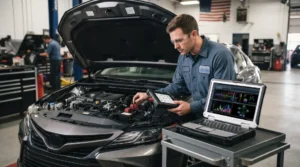
Diagnostic equipment has always been an important part of modern auto repair, but software-defined vehicles are increasing the amount of information technicians can access.
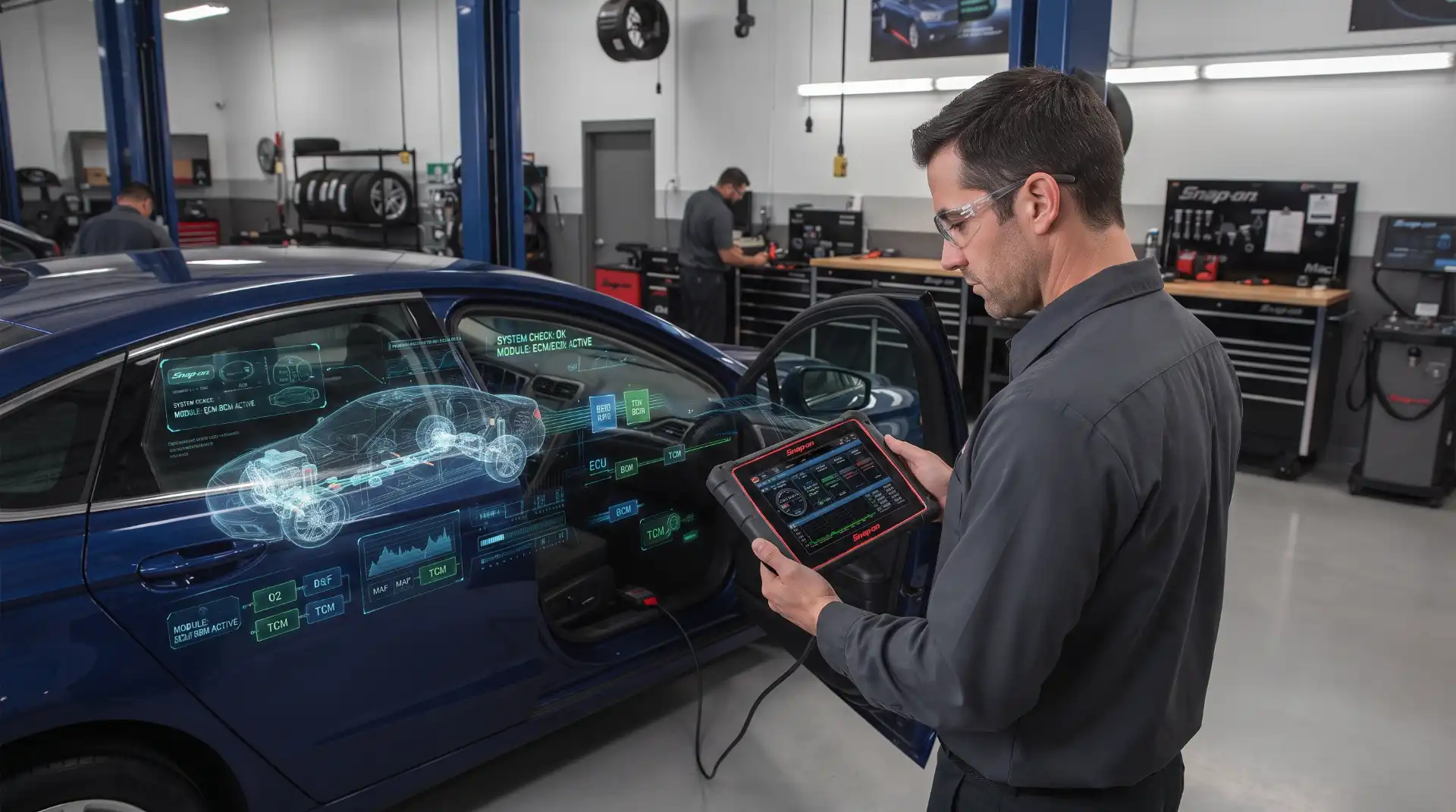
A modern diagnostic scan can potentially provide information from numerous electronic control modules. Depending on the vehicle, technicians may be able to retrieve fault codes, sensor readings, communication errors, software information, system status, and other data.
This can make diagnosis more precise, but it can also make the process more complicated.
A diagnostic code does not necessarily mean that the component named in the code is defective.
Suppose a vehicle reports a problem involving a temperature sensor. The sensor itself could have failed, but the problem might instead involve damaged wiring, a poor electrical connection, an abnormal power supply, another component influencing the sensor signal, or software interpreting the data incorrectly.
Replacing the sensor without determining the underlying cause may fail to solve the problem.
This is why professional diagnosis matters.
A skilled technician uses the diagnostic information as evidence rather than treating a computer-generated code as an automatic parts-ordering instruction.
Electronic Control Modules Are Becoming Central to Repairs
Electronic control modules are another reason software is changing automotive repair.
Modern vehicles may contain numerous modules responsible for different functions. Depending on the vehicle, these can control the engine, transmission, body electronics, braking systems, airbags, battery management, driver assistance, infotainment, lighting, and other functions.
When a module fails, replacing it may not be as simple as installing a new physical component.
The replacement module may need to be programmed for the vehicle.
It may need specific software, configuration settings, security authorization, vehicle identification information, or communication settings before it can operate correctly.
A repair that looks simple from the outside can therefore involve multiple stages.
A technician may have to diagnose the original failure, replace the component, program the replacement module, clear or verify fault codes, perform calibration, and test the vehicle.
This additional work can increase repair time and cost.
CarrSS already covers this issue in its article about repairing or replacing a car with expensive electronic problems, which explains why modern electronic repairs can involve diagnostics, programming, calibration, and manufacturer-specific equipment.
That subject is becoming increasingly relevant as software becomes more deeply integrated into vehicles.
ADAS Is Creating a New Category of Vehicle Service
Advanced driver-assistance systems, or ADAS, provide another clear example of software-driven automotive technology.
Many newer U.S. vehicles can include features such as automatic emergency braking, forward collision warning, adaptive cruise control, lane-departure warning, lane-keeping assistance, blind-spot monitoring, parking assistance, and camera-based visibility systems.
These technologies depend on a combination of physical hardware and software.
Cameras, radar sensors, ultrasonic sensors, electronic control modules, wiring, and software must all work together.
This creates an important issue for repair facilities.
A repair that does not appear to involve software can sometimes affect an ADAS system.
For example, a windshield replacement may involve a forward-facing camera mounted near the windshield. A collision may affect the position of a radar sensor. Suspension or alignment work may influence the geometry used by certain systems.
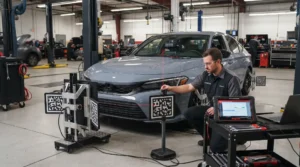
After certain repairs, calibration may therefore be necessary.
A vehicle owner should ask whether calibration is required whenever a repair involves cameras, radar, sensors, windshield systems, suspension geometry, or collision damage.
NHTSA explains that modern advanced driver-assistance technologies depend on electronics, sensors, and computer systems and that cybersecurity is an important consideration as these technologies develop.
The lesson is that repairing the physical component may only be one part of restoring the entire system.
Why Calibration Matters After Certain Repairs
Calibration is becoming an increasingly important part of modern automotive service.
A camera or radar sensor can be physically present and functioning while still providing inaccurate information if it is not correctly positioned or calibrated.
Consider a forward-facing camera used by a driver-assistance system.
The camera must understand where the vehicle is positioned relative to lane markings, road surfaces, vehicles, and other objects. If its physical position changes, the software may interpret the environment differently.
The same principle can apply to radar sensors.
A small change in sensor angle can affect how information is interpreted.
This is why professional repair facilities increasingly use specialized calibration equipment.
For drivers, the practical takeaway is straightforward: if a vehicle has advanced driver-assistance features, ask whether those features need to be recalibrated after relevant repairs.
Ignoring this question could leave a vehicle with a system that appears functional but is not operating according to its intended specifications.
Vehicle Cybersecurity Is Becoming Part of Automotive Technology
Connected vehicles introduce another issue that was less prominent in traditional vehicles: cybersecurity.
Modern cars can communicate with smartphones, mobile networks, Wi-Fi systems, cloud services, charging infrastructure, and other digital systems.
Connectivity provides useful features, but it also creates additional points that manufacturers need to protect.
NHTSA explains that vehicle cybersecurity is important because modern vehicles depend on complex software and connected electronic systems, including systems that influence vehicle safety. The agency promotes a layered cybersecurity approach designed to reduce potential risks.
For drivers, cybersecurity is not necessarily something they need to manage manually every day.
Instead, it is one reason software maintenance matters.
An update may address more than a minor convenience issue. In some circumstances, manufacturers can use software updates to address vulnerabilities, change system behavior, or improve protections.
This is also why drivers should be careful with unauthorized modifications to connected vehicle systems.
Adding third-party hardware or software can potentially change how electronic systems interact with one another.
Owners should understand what a modification does before installing it.
A Weak Battery Can Still Cause Electronic Problems
Software-defined vehicles are technologically advanced, but they still depend on basic electrical principles.
The 12-volt battery remains an important component in many modern vehicles.
It powers numerous electronic systems and helps provide the electrical energy needed to start conventional vehicles. Depending on vehicle design, it also supports control modules, lighting, infotainment, sensors, security systems, and other electronics.
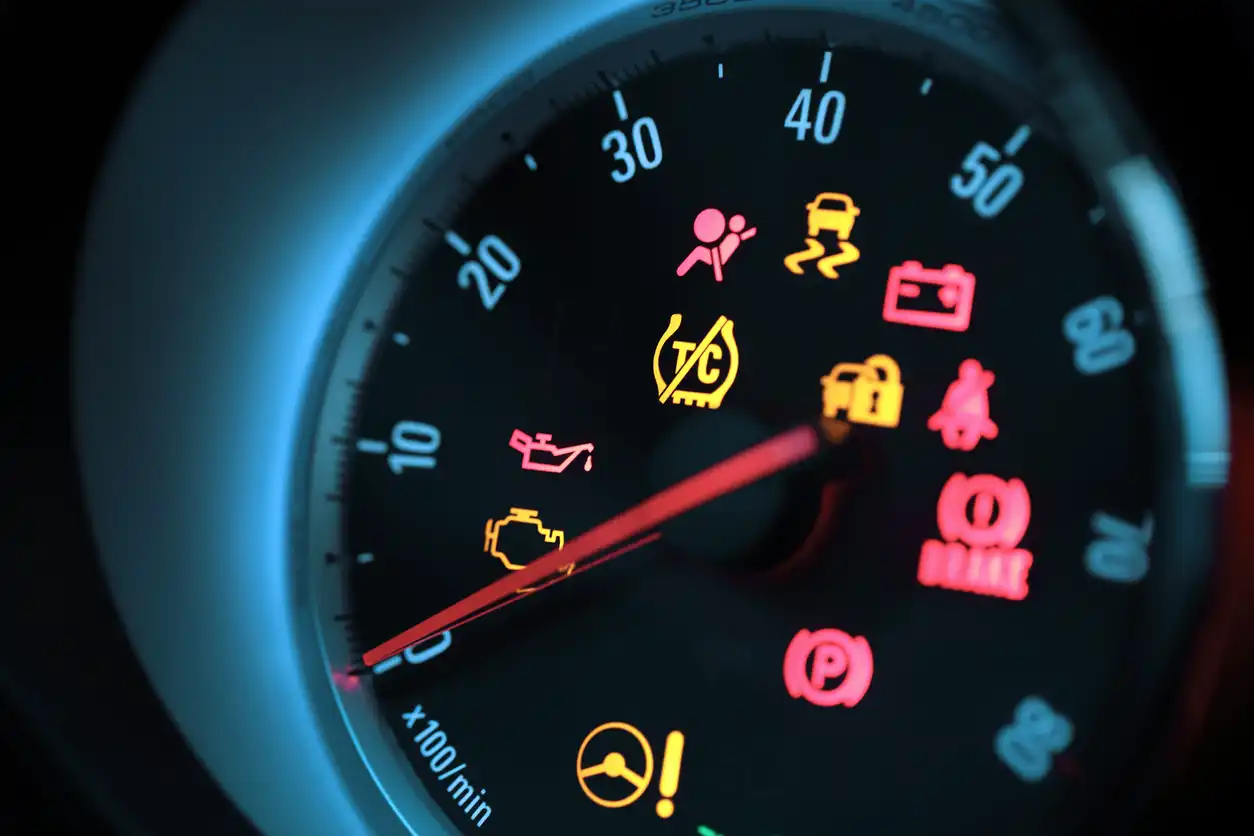
When battery voltage becomes unstable, a vehicle may produce multiple warnings or unusual electronic symptoms.
A driver might see several dashboard warnings at once and assume that numerous components have failed.
In reality, low voltage can sometimes cause multiple electronic systems to behave abnormally.
This is why technicians may perform basic battery and charging-system tests before pursuing a complex electronic diagnosis.
CarrSS’s existing guide on why a car won’t start but still has power provides useful background for drivers dealing with unusual starting and electrical symptoms.
The more software a vehicle contains, the more important it becomes to maintain the electrical foundation that supports those systems.
Software Can Make Preventive Maintenance More Intelligent
Traditional preventive maintenance is generally based on mileage, time, operating conditions, and manufacturer recommendations.
Software-defined vehicles can potentially supplement those traditional methods with more detailed information.
A vehicle may monitor temperatures, battery performance, system faults, operating conditions, and other data depending on its design.
This can support predictive maintenance.
Instead of waiting for a component to fail completely, software may identify unusual conditions that deserve inspection.
For example, a system may detect an abnormal battery condition or repeated communication fault before the driver experiences a complete breakdown.
However, drivers should not assume that vehicle software eliminates preventive maintenance.
Physical components still age.
Tires can deteriorate. Brake components wear. Fluids change over time. Rubber hoses and belts can become damaged. Suspension components can develop wear.
Software can monitor certain conditions, but it cannot replace every physical inspection.
CarrSS’s guide to essential car maintenance for older vehicles explains why age, mileage, driving conditions, and maintenance history all remain important when caring for a vehicle.
Software should be viewed as another maintenance resource, not as a replacement for basic vehicle care.
How Software Can Affect Repair Costs
One of the biggest concerns for drivers is whether software-defined vehicles will be more expensive to repair.
There is no universal answer.
Some software-related repairs may actually reduce costs.
An OTA update can potentially correct certain problems without requiring a physical repair. Remote diagnostics can provide information before a vehicle reaches a shop. Software monitoring may help identify problems earlier.
Other situations can become more expensive.
Specialized diagnostic equipment costs money. Technician training costs money. Manufacturer software access may involve fees. Programming and calibration require time and equipment.
Electronic components can also be expensive.
A failed control module may not be physically large, but it can be an important part of the vehicle’s overall architecture.
In addition, diagnosing intermittent electronic problems can require significant labor.
This means that drivers should focus on the quality of the diagnosis rather than assuming that a software-related repair should automatically be cheap or expensive.
A detailed diagnosis can help distinguish a straightforward update from a failed module, wiring problem, sensor issue, or larger electronic-system failure.
Independent Repair Shops Are Adapting
The growth of software-defined vehicles is also changing the independent repair industry.
Independent shops have traditionally competed by offering specialized expertise, convenient service, and often lower labor costs than dealerships.
As vehicles become more software-dependent, independent facilities may need to invest in advanced scan tools, programming equipment, calibration systems, technical databases, and technician training.
That does not mean dealerships are the only places capable of repairing modern vehicles.
Many independent shops have extensive experience with electronic diagnostics and advanced automotive systems.
The important factor is whether the shop has the appropriate capabilities for the specific vehicle and repair.
Before approving a complicated electronic repair, drivers can ask whether the facility has experience with the vehicle’s particular electronic architecture.
For an ADAS issue, ask whether the shop performs calibration.
For module replacement, ask whether programming is available.
For software-related faults, ask whether the technicians have the diagnostic information and tools needed to identify the root cause.
These questions can prevent unnecessary delays.
Why Diagnostic Skill Matters More Than Ever
Software-defined vehicles do not necessarily make mechanics less important.
In many ways, they make diagnostic skill even more important.
A scan tool can provide information, but someone must interpret that information.
A computer can report a communication error, but a technician must determine whether the cause is a module, wiring harness, connector, power supply, network problem, software issue, or another component.
The same principle applies to sensor errors.
A vehicle can report that a sensor reading is outside the expected range. The technician must determine why.
This requires knowledge of electrical systems, mechanical systems, software, vehicle networks, and manufacturer-specific procedures.
The modern technician increasingly has to be both a mechanic and a diagnostician.
That combination is likely to become even more important as vehicles continue to evolve.
Why Car Owners Should Keep Software and Service Records
Vehicle owners have traditionally been encouraged to keep records of oil changes, tire replacements, brake work, and other maintenance.
Software-defined vehicles make detailed records even more useful.
A service record can document software updates, module replacements, diagnostic findings, sensor calibration, battery replacements, recalls, and other electronic repairs.
This information can help technicians diagnose recurring problems.
Suppose a vehicle begins reporting an electronic communication fault after a major repair. Knowing what work was performed previously can provide an important clue.
Service records can also help when a vehicle is sold.
A buyer may want to know whether important electronic systems have been repaired or replaced and whether the vehicle has received recommended updates.
Maintaining a detailed history can therefore provide value beyond immediate maintenance.
Software Updates and Safety Recalls Are Different
Drivers should also understand the difference between a routine software update and a safety recall.
A software update can be released to improve performance, fix a bug, modify functionality, or address another software-related issue.
A safety recall involves a safety-related defect or noncompliance that meets applicable federal requirements and requires a remedy.
Not every software update is a recall.
However, some safety recalls can involve software.
NHTSA has documented cases in which manufacturers have used software updates as part of safety-related campaigns. The agency’s research also specifically examines OTA updates as a method for delivering software changes.
Drivers should therefore check official recall information rather than relying only on notifications displayed inside the vehicle.
For U.S. vehicle owners, the National Highway Traffic Safety Administration’s vehicle cybersecurity resources provide authoritative information about the role of software, electronics, cybersecurity, and connected vehicle systems.
What Happens When a Software Problem Appears?
When a vehicle displays a software-related warning, the first step should be understanding exactly what the vehicle is reporting.
A driver should note the warning message and determine whether it concerns a safety-critical system.
Warnings involving brakes, steering, overheating, airbags, major powertrain problems, or other critical systems should be treated seriously.
The owner’s manual can provide information about the meaning of many warning messages and recommended actions.
For less urgent electronic problems, owners can check whether a manufacturer software update is available.
If the problem continues, professional diagnosis may be appropriate.
Drivers should also record when the problem occurs.
Was it during startup?
Did it happen after rain?
Did it appear when the battery was weak?
Did several warning lights appear at the same time?
Did the problem disappear after restarting?
These details can help a technician reproduce the problem.
Why Restarting the Vehicle Is Not Always a Real Fix
Modern electronics can sometimes behave differently after a vehicle is turned off and restarted.
A warning may disappear.
A system may begin working normally again.
That can create the impression that the problem has been fixed.
However, an intermittent problem can still be present.
If a warning disappears after restarting, drivers should still document what happened, particularly if the issue returns.
Intermittent electrical and software problems can be difficult to diagnose because the technician may not immediately see the symptom.
A detailed history can make the diagnostic process more efficient.
How Drivers Can Choose the Right Repair Facility
Selecting an appropriate repair facility is increasingly important as vehicles become more complex.
Drivers should consider the type of problem rather than simply searching for the cheapest repair estimate.
A shop that specializes in routine oil changes may not be the best choice for a complicated ADAS calibration problem.
Similarly, a facility that specializes in mechanical repairs may not have the programming tools needed for a sophisticated control-module replacement.
This does not mean every repair requires a dealership.
Independent repair shops can have extensive capabilities.
The important issue is whether the facility has the right equipment, training, diagnostic information, and experience.
CarrSS’s existing resource on choosing a trusted auto repair shop provides additional guidance about evaluating repair facilities, communication, service quality, and vehicle care.
For complicated electronic repairs, transparent communication is particularly important.
Questions to Ask Before Approving a Software-Related Repair
When a repair shop recommends a significant electronic repair, drivers should ask what exactly has failed.
“Computer problem” is too broad.
Ask which module or system is involved and how the technician confirmed the diagnosis.
Drivers can also ask whether the problem is software, hardware, wiring, sensor-related, or a combination.
Another useful question is whether a software update or manufacturer service campaign applies to the vehicle.
If a component needs to be replaced, ask whether programming or calibration is required and whether those procedures are included in the estimate.
The owner should also ask whether the repair affects a safety-related system.
These questions do not require technical expertise. A professional repair facility should be able to explain the issue in understandable terms.
When a Second Opinion Can Help
Electronic vehicle repairs can be expensive, particularly when they involve control modules, wiring, ADAS components, or extensive diagnostics.
A second opinion can sometimes be useful when the diagnosis is unclear or the estimate is substantial.
The goal is not necessarily to find the lowest price.
The goal is to determine whether the diagnosis is accurate and whether the proposed repair addresses the underlying problem.
A second shop may confirm the original diagnosis, identify a different cause, or offer another repair approach.
This can be particularly valuable when an electronic problem is intermittent.
A written diagnostic explanation and repair estimate can make comparisons easier.
Are Software-Defined Vehicles More Difficult to Maintain?
They can be more complicated, but complexity does not automatically mean poor reliability.
Modern vehicles have many systems that older vehicles did not have.
That additional technology creates more components and software interactions that technicians may need to understand.
At the same time, software can provide benefits that older vehicles did not have.
A vehicle can monitor more systems. Manufacturers can sometimes correct software problems remotely. Diagnostics can provide more information. Certain maintenance conditions can be monitored continuously.
The key issue is learning how to maintain the entire system.
Drivers should no longer think exclusively in terms of mechanical maintenance.
They should think about mechanical health, electrical health, software health, sensor condition, cybersecurity, and manufacturer updates as interconnected parts of modern vehicle ownership.
What About Older Vehicles?
The growth of software-defined vehicles does not mean older cars suddenly become obsolete.
In fact, older vehicles can still offer important advantages.
Their systems may be simpler, and many repairs can be completed without specialized software programming.
However, older vehicles still contain electronic systems, and replacement parts or modules can sometimes become difficult to obtain as vehicles age.
Owners of older cars should therefore continue maintaining their vehicles according to manufacturer recommendations and should not ignore electronic warning signs.
CarrSS’s article on car maintenance in 2026 for older vehicles explains why age, mileage, fluids, batteries, belts, brakes, tires, suspension, and service history all remain important.
Software may be changing the newest vehicles, but the fundamentals of good maintenance remain relevant.
The Future of Auto Repair Will Be Both Mechanical and Digital
The automotive repair industry is entering a period where mechanical expertise and digital expertise increasingly overlap.
A future service appointment may involve a technician scanning the vehicle, checking software versions, examining network communication, testing sensors, performing a physical repair, programming a replacement module, calibrating an ADAS system, and then validating the entire vehicle.
That may sound more complicated than traditional auto repair, but it can also provide better information.
Modern software can help technicians identify faults and monitor vehicle conditions.
Connected systems may provide data that was previously unavailable.
OTA updates can potentially correct certain issues without requiring a physical service visit.
At the same time, technicians still need to understand the physical vehicle.
A computer cannot replace the need to inspect a leaking hose, worn brake component, damaged tire, failed bearing, or broken suspension component.
The future of automotive repair is therefore not purely digital.
It is a combination of mechanical inspection, electronic testing, software diagnosis, physical repair, and system validation.
How U.S. Drivers Can Prepare for Software-Defined Vehicles
American drivers do not need to become computer programmers to own a software-defined vehicle.
A few practical habits can make ownership easier.
First, understand the technology installed in your vehicle. Know whether it has adaptive cruise control, automatic emergency braking, lane assistance, parking cameras, blind-spot monitoring, or other advanced features.
Second, pay attention to legitimate software-update notifications.
Third, maintain the vehicle’s battery and electrical system.
Fourth, keep detailed service records.
Fifth, check safety recalls through official sources.
Sixth, use a repair facility that has the appropriate equipment and experience when an electronic problem occurs.
Most importantly, do not ignore unusual behavior simply because the vehicle continues to drive.
An electronic problem can begin as an intermittent warning and become more significant later.
Early diagnosis may provide more options and reduce uncertainty.
Final Thoughts: Software Is Becoming Part of Everyday Car Maintenance
Software-defined vehicles are changing what it means to own and repair a car.
The modern vehicle still depends on engines, motors, transmissions, brakes, tires, steering systems, suspension components, cooling systems, and other physical hardware.
But those systems increasingly operate alongside sophisticated software and electronic networks.
That means vehicle maintenance is becoming a combination of mechanical care and digital care.
Over-the-air updates can address certain problems without a shop visit. Diagnostic software can provide technicians with more information. Electronic modules can coordinate complex vehicle functions. ADAS technology can depend on precise calibration. Connected vehicles require attention to cybersecurity.
At the same time, traditional maintenance remains essential.
A software update cannot replace worn tires. A diagnostic scan cannot repair a damaged brake line. An OTA update cannot fix a leaking radiator or broken suspension component.
The most effective approach is to understand how the mechanical and digital sides of the vehicle work together.
For drivers in the United States, this means following the manufacturer’s maintenance schedule, paying attention to software updates, monitoring warning messages, checking recalls, maintaining service records, and selecting repair professionals with the appropriate diagnostic capabilities.
The software-defined vehicle is not a replacement for the traditional automobile.
It is the next stage in the evolution of the automobile.
As software becomes more deeply integrated into transportation, understanding these systems will become an increasingly important part of responsible vehicle ownership. The drivers and technicians who recognize that mechanical and digital systems are connected will be better prepared to diagnose problems, maintain vehicles, and keep modern cars operating as intended.